The 7-Day Rule for Short-Term Rentals: How Material Participation Makes an STR Non-Passive
By Jason Tarabokija, licensed New Jersey real estate salesperson with New Jersey Elite Group, LLC. ·
 Vacation rental houses along Route 35 in Chadwick Beach, in the Dover Beaches North section of Toms River Township. Photo: Mr. Matté, CC BY-SA 4.0, via Wikimedia Commons.
This is general information, not tax, legal, or financial advice. Figures are illustrative examples. Review your situation with your CPA before acting.
The 7-day rule short-term rental owners hear about works like this: if the average guest stay at your property is seven days or less, the IRS does not treat it as a "rental activity." If you also materially participate in running it, any loss is non-passive and can offset W-2 wages. Both tests apply every tax year, separately.
This is the first deep dive in our W-2 series. For the full strategy, start with our pillar, The Short-Term Rental Tax Strategy for High-Earning W-2 Professionals.
Why passive vs non-passive matters
IRS Publication 925 treats most rentals as passive, even when you do the work yourself. Passive losses can usually only offset passive income, so for a W-2 earner a rental loss often sits unused on the return.
The short-stay exception changes the starting point. A property with short average stays is treated like any other business, and a business you materially participate in is not passive.
How the 7-day average works
The rule itself is short: if the average guest stay at your property for the year is seven days or less, the IRS does not treat it as a typical rental activity.
 Small bungalows along Route 35 in Dover Beaches North, Toms River Township, the kind of Shore homes often rented for short stays. Photo: Mr. Matté, CC BY-SA 4.0, via Wikimedia Commons.
To find your average, add up the nights in every stay during the year and divide by the number of stays. Empty nights and your own nights at the house do not count.
Here is where one booking can undo a season.
Hypothetical (illustration only, not a real Breezy property): An owner books 30 summer and shoulder-season stays totaling 150 nights. 150 divided by 30 is an average of 5.0 nights. Earlier that same year, the owner had one winter tenant from January through April, 120 nights. Now it is 270 nights divided by 31 stays, an average of about 8.7 nights. The property no longer meets the seven-day test for that year.
That is why a long off-season lease is the most common way a Shore owner breaks the rule. (Your CPA can walk you through any exceptions.)
The material participation tests that matter
Passing the 7-day test is only half. You also have to materially participate, which means working in the rental on a regular, continuous and substantial basis. There are several ways to qualify. These three fit most short-term rental owners:
- More than 500 hours on the activity during the year.
- Doing substantially all of the work on the property yourself.
- More than 100 hours, and at least as much as any other individual, including people you pay.
Owners lean on the third test, and it is where they get caught. "Any other individual" means each person: your cleaner, your handyman, a co-host, a manager's staff member. If one of them logs more time than you, that test fails.
Whose hours count, and which hours count
Spouse hours count. Your spouse's work on the property counts as yours, even if your spouse is not on the deed.
Real work counts. Day-to-day work on the property counts: guest messaging, pricing, turnovers you handle, restocking, meeting contractors.
Some work does not count:
- Investor work, like reading monthly statements, usually does not count unless you also run the day-to-day operations.
- Work owners do not usually do, if one of the main reasons for doing it is to avoid the passive loss rules.
- Being "on call." Time spent waiting by the phone does not count. Only actual work does.
Why year one is self-managed
This follows from the third test. A full-service manager and its cleaners and vendors will almost always out-hour you. That is why the pillar post suggests self-managing from launch through December 31, then handing the home to Breezy in January.
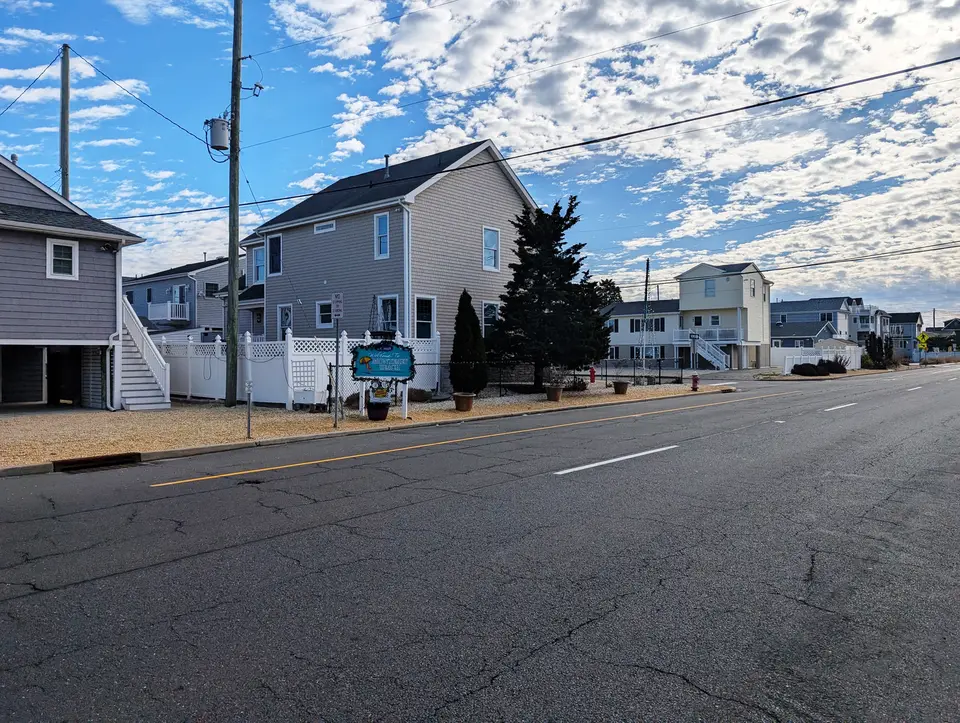 Elevated vacation homes along Route 35 at Monterey Beach in Toms River Township. Photo: Mr. Matté, CC BY-SA 4.0, via Wikimedia Commons.
Material participation is an annual test, so meeting it in year one does not carry into year two. Year one is usually when the large depreciation deduction lands, so it is when the hours matter most.
Our pillar post's 506 Bay Blvd example, a Seaside Heights purchase Breezy worked on, shows what is at stake: purchase price was $969,000, a cost segregation study identified $137,975 as components with short tax lives eligible for 100 percent bonus depreciation in year one, and total depreciation for 2025 came to $143,061. A deduction that size only counts against wages if the property passes the average stay test and the owner materially participates that year. For more on how bonus depreciation works with a Shore purchase, see How Bonus Depreciation Makes Vacation Rentals the Smartest Investment.
Personal use: the 14-day or 10% limit
Using the house yourself can cancel the loss even when both tests are met. Per IRS Publication 527, if your personal days exceed the greater of 14 days or 10% of the days it is rented at a fair rental price, rental expenses above your rental income cannot offset your other income. Expenses you can't deduct that year generally carry forward to the next year, subject to the same limit. Ask your CPA how your own plans affect this.
Family stays count as personal days unless the relative pays a fair rent and it is their main home. A day spent working substantially full time on repairs is not a personal day.
How to log hours so they hold up
You do not need a special app or a daily time sheet. A calendar or notes kept as you go is enough. What does not hold up is a rough estimate pieced together at tax time.
In one 2025 Tax Court case, an owner claimed more than 900 hours from a log built on estimates. The court counted fewer than 100 hours, and the loss stayed passive.
A log that holds up looks like this:
- Same-day or same-week entries with the date, task and time spent.
- Backup for each: guest messages, vendor texts, invoices, calendar entries.
- Spouse hours logged separately, by name.
- Who else worked on the property and roughly how long.
Planning for a 2027 purchase? Key dates for the 2027 tax year
- Both tests are measured for the 2027 tax year: the 7-day average across stays that end in 2027 (or run through December 31, 2027), and your hours from January 1 to December 31, 2027.
- For depreciation to start in 2027, the home must be placed in service by December 31, 2027. In plain terms, a rental is placed in service when it is ready and available for rent, even before the first guest arrives.
- Self-manage and log hours from the day the listing goes live through December 31, 2027.
- Hand-off to a full-service manager: January 2028, after the 2027 tax year closes.
Frequently Asked Questions
What is the 7-day rule for short-term rentals?
If the average guest stay is seven days or less for the year, the IRS does not treat the property as a typical rental. You still need to materially participate in running it for a loss to offset wage income. Your CPA can confirm how it applies to you.
Do my spouse's hours count toward material participation?
Yes. Your spouse's work on the property counts as yours, even if your spouse is not an owner.
How do you calculate the average guest stay?
Divide the total number of days in all rental periods by the number of rentals in the tax year. Vacant nights and your own nights at the house are not part of it.
Can one long winter tenant break the 7-day rule?
Yes. In our illustration, 30 stays totaling 150 nights average 5.0 nights, but one 120-night winter tenant raises the average to about 8.7 nights, which fails the test for that year.
Which hours count toward material participation?
Real operating work, such as guest messaging, pricing, turnovers, restocking and meeting contractors. Investor work, like reviewing statements, and "on call" time do not count.
Talk to Breezy about your property
Planning a 2027 purchase at the Shore? Start with the property, not the deduction. We can show you which towns support short stays, a realistic first season, and how we take over after your self-managed year.
Talk to Breezy about full vacation rental management, see how we help buyers on Buy with Breezy, or book a 30-minute call.
This is general information, not tax, legal, or financial advice. Figures are illustrative examples. Review your situation with your CPA before acting.
Sources (accessed November 9, 2026)
- Treas. Reg. 1.469-1T(e)(3)(ii)(A), eCFR: https://www.ecfr.gov/current/title-26/section-1.469-1T
- Treas. Reg. 1.469-1(e)(3)(iii), average period of customer use, eCFR: https://www.ecfr.gov/current/title-26/section-1.469-1
- Temp. Treas. Reg. 1.469-5T, material participation tests, (f)(2), (f)(3), (f)(4), eCFR: https://www.ecfr.gov/current/title-26/section-1.469-5T
- IRS Publication 925 (2025), Passive Activity and At-Risk Rules: https://www.irs.gov/publications/p925
- IRS Publication 527 (2025), Residential Rental Property: https://www.irs.gov/publications/p527
- IRS Publication 946 (2025), How To Depreciate Property (placed in service): https://www.irs.gov/publications/p946
- Moss v. Commissioner, 135 T.C. 365 (2010), via OpenJurist: https://openjurist.org/135/tc/365/moss-v-commissioner-4561059
- Mirch v. Commissioner, T.C. Memo. 2025-128 (Dec. 11, 2025), via vLex: https://case-law.vlex.com/vid/mirch-v-comm-r-1098620075
- Breezy Beach Stays, The Short-Term Rental Tax Strategy for High-Earning W-2 Professionals (506 Bay Blvd example): https://www.breezybeachstays.com/the-short-term-rental-tax-strategy-for-high-earning-w-2-professionals/