Ortley Beach Short-Term Rental Rules: Toms River's April to November Season, Certificates, and Inspections
By Jason Tarabokija, licensed New Jersey real estate salesperson with New Jersey Elite Group, LLC. ·
This is general information, not legal advice. Rules change, so confirm your property's requirements with Toms River Township before you list, buy, or book.
Yes, you can run a short-term rental in Ortley Beach, but only part of the year. Toms River code bans rentals under 30 days township wide, except on the barrier island, where stays of at least two days are allowed from April 1 through November 30. From December through March, plan on 30-day or longer rentals.
To rent legally under the Ortley Beach short-term rental rules, you also need a Rental Certificate of Inspection from the township, an annual insurance registration, a passed inspection, and your registration number on every ad. This guide walks through each piece for current owners and for buyers comparing Ortley Beach with Seaside Heights or Lavallette.
Who sets the Ortley Beach short-term rental rules?
Ortley Beach is not its own borough. It is a section of Toms River Township that sits on the barrier island between Lavallette and Seaside Heights, as the township's beaches page describes it. That means Toms River's ordinances apply, not Lavallette's and not Seaside Heights'.
This trips up buyers. Cross the town line north or south and you are under a different process. Seaside Heights runs its own approval system, which we cover in our Seaside Heights short-term rental approval guide. Lavallette is also its own borough, so check its rules separately if you are shopping both.
Two parts of Toms River's Chapter 335 matter most: Article VI, Short-Term Rentals, and Article II, Rental Properties, which covers certificates, inspections, fees, and occupancy.
Toms River's 30-day rule and the Ortley Beach exception
Section 335-39 of the township code is short: no dwelling, or any part of one, may be rented for less than 30 days. Section 335-40, amended in May 2017 by Ordinance 4546-17, carves out the exception that makes Ortley a rental town. On the barrier island, "minimum rentals of two days are permitted during the period from April 1 through November 30."
The code defines the barrier island as the part of the township between Barnegat Bay and the Atlantic Ocean, which is where Ortley sits.
The history explains the shape of the rule. In 2017, Shorebeat reported that the council was cutting the island minimum from three days to two and stretching the season to April 1 through November 30. A summer week or a two-night October weekend works. A one-night stay never does, and mainland Toms River homes cannot take stays under 30 days.
What December through March means for your calendar
Outside April 1 through November 30, the barrier island exception does not apply, so the township-wide 30-day minimum takes over. The township's Rental Certificate of Inspection packet (revised October 2024) states it plainly: seasonal and short-term rental certificates are valid April 1 through November 30 on the barrier island, and seasonal and short-term rentals "are not permitted outside of that period."
So close your short-stay calendar on November 30, and set a 30-night minimum (or block dates) for December through March. Your ads matter too: Section 335-44 of the code bans advertising any rental that does not comply, so a listing showing open January weekends is a problem by itself. Monthly renters are the usual winter answer, and our guide to off-season rentals at the Jersey Shore covers who books then.
A winter tenancy of 30 days or more is a different kind of rental under the code. Section 335-4 of Article II defines a seasonal or short-term rental as a stay under 30 days, but no shorter than two days, between April 1 and November 30 on the barrier island, and treats everything else as a nonseasonal rental. Nonseasonal certificates run on a three-year cycle, need a new inspection after a change in occupancy (Sections 335-6 and 335-7), and require tenant screening for each new tenant (Section 335-17). Before you sign a winter tenant, ask the Division of Property Maintenance how to register the house for both uses.
How to get a Toms River Rental Certificate of Inspection
No rental unit in Toms River can be rented, occupied, or advertised until it is registered and certified, according to Section 335-5 of Article II. The township now calls this document the Rental Certificate of Inspection, and all applications go through the online SDL Portal. Paper applications are no longer accepted, per the Property Maintenance page.
The township's application page lays out the order:
- Register your certificate of insurance first.
- In the SDL Portal, choose Online Requests, then Code Enforcement/Housing Applications, then Rental Certificate of Inspection.
- Upload the application, insurance registration, and any heat or well water certificates.
- Pay by credit card, then wait for Code Enforcement to call and schedule the inspection.
Fees. Section 335-10 of the code sets $150 for registration and inspection, $50 for an amended registration, and $50 for a reinspection, with a $35 late charge if a fee goes unpaid 30 days past its due date. The inspection packet lists the same $150, $50, and $50 and says the fees are non-refundable. If electrical repairs come up and you cannot show a licensed electrician's invoice, the packet says the electrical reinspection costs $150. Fees can change, so confirm the current schedule with the Division of Property Maintenance before you budget.
Timing. The packet requires at least 5 days' notice to schedule an inspection, and at least 10 days' notice between May 1 and July 15. Section 335-7 of the code says seasonal rentals must be inspected and certified annually on or before April 30, and again after a change of ownership, but not when guests change. Section 335-6 sets the seasonal certificate term at one year starting January 1, and the packet says short stays under it are allowed only April 1 through November 30. In practice, that means one renewal and one inspection every year. So the practical deadline for a spring opening is late winter, not Memorial Day.
Paperwork for owners who live away. If your address of record is outside Ocean County, Section 335-11 requires you to name an Ocean County resident to accept notices for you, plus an emergency contact reachable at any time who can approve repairs. Changes must be filed within 20 days (Section 335-13), and municipal taxes and water and sewer charges must be current before a certificate is issued (Section 335-16).
The annual certificate of insurance under P.L. 2022, c.92
New Jersey's P.L. 2022, c.92 requires towns to verify landlord insurance, and Toms River has applied it to every rental unit since January 1, 2023, according to the township's Property Maintenance page. The township page says owners must register their certificate of insurance every year, on or before January 1, through the SDL Portal.
The same page says the owner of a rental unit must carry liability insurance of at least $500,000 for combined property damage and bodily injury per occurrence. Ask your agent for a policy written for short-term rental use, since Section 335-9 of the code requires properties to be "fully insured for rental purposes" for the whole certificate term.
Because insurance registration comes first, a lapse can stall your season. Set a December reminder.
What the Toms River rental inspection checks
The inspection packet says its list is a guide and not all inclusive, but these are the items owners should walk through before the visit:
- Smoke alarms. Rules depend on the build year under N.J.A.C. 5:70-4.19, and every level needs a working alarm, basements included. Homes built before 1984 need at least 10-year sealed battery alarms on each level and within 10 feet of each sleeping area. Homes built from 1984 through 1990 need interconnected hardwired alarms with battery backup on each level. Homes built in 1991 or later need those in each bedroom too, and within 10 feet outside each bedroom door. If you renovated or added on, the packet says your alarms should have been upgraded. Any battery-only alarm must be a 10-year sealed unit.
- Carbon monoxide alarms. Within 10 feet of sleeping areas, unless the unit has no fuel-burning appliance and no attached garage.
- Fire extinguisher. Within 10 feet of the kitchen in the path of egress, rated at least 2A-10B:C, mounted, and serviced and tagged within the past 12 months.
- GFCI outlets. Within 6 feet of any water source, including kitchens, baths, laundry, garages, and outdoor outlets.
- Windows and handrails. At least one operable window in every bedroom and living room; handrails where there are 4 or more risers over 30 inches and on egress stairs.
- Utilities. Electric, gas, and water must be on, even for seasonal rentals.
Houses closed all winter tend to fail on small things: a dead alarm, an expired extinguisher tag, a tripped GFCI. Walk through a week ahead.
Seasonal exemptions: heat certificate and lead-safe certificate
Two requirements that apply to year-round rentals are relaxed for seasonal barrier island rentals, according to the packet:
- Heat certificate. Year-round rentals need a heat certificate from a licensed professional for all fuel-burning heat sources. The packet says seasonal rentals on the barrier island are exempt.
- Lead-safe certificate. Rental homes built before 1978 need a lead-safe certificate under New Jersey's lead law, P.L. 2021, c.182, which the township began enforcing April 1, 2023 (Property Maintenance page). The packet says seasonal rental dwellings rented for less than six months are exempt.
If you add a winter tenant of 30 days or more, ask the township whether these exemptions still apply, especially for a pre-1978 house.
Your registration number goes on every ad
Each registration and certificate gets its own number, and Section 335-5 of the code says that number "must appear prominently in any advertisement" for the unit. The packet adds that the registration number is assigned when you apply and stays valid for three years. That number is separate from the certificate itself, which a seasonal rental still renews and reinspects every year.
Put it in your Airbnb and Vrbo descriptions, on your direct booking site, and on any social post.
A Rental Certificate of Inspection is not a zoning approval
The packet is clear that a Rental Certificate of Inspection "is not an approval for zoning, fire, or building code requirements." If you finished a ground floor, added a bedroom, or converted a garage, the inspection does not bless that work. Check with the township's zoning, fire, and building departments separately.
What the ordinance bans outright
Article VI includes three bans that surprise owners, all in the township code:
- Amenity rentals (Section 335-43). You cannot rent out any amenity, feature, or accessory of a home for any purpose. That covers listing a pool by the hour or renting a yard for a party. Shorebeat reported in 2017 that the ban came after residents complained about homes and pools being rented for special events.
- Commercial or corporate rentals (Section 335-42). Renting a dwelling for commercial or corporate purposes is prohibited.
- Room-by-room rentals (Section 335-41). Renting multiple rooms is prohibited. A single room is allowed only in a year-round owner-occupied home, for at least one month.
Occupancy limits, guest conduct, and penalties
Occupancy. Your certificate lists a maximum occupancy, set by Section 335-14 of the code. Each bedroom needs at least 70 square feet for one person, plus 50 square feet for each additional person. Living rooms, dining rooms, and kitchens have their own minimums, and decks and porches are capped at one person per 9 square feet. Section 335-15 also bars renting to more people than the sleeping accommodations listed on your certificate. List guest counts by the certificate, not by bed count.
Conduct. Section 335-19 says a rental cannot be used in a way that causes unreasonable disturbances to neighbors. At Breezy, the person booking must meet the minimum age on each listing, typically 25, which is one way we screen for the trips that cause trouble.
Penalties. Violations of Article VI carry the maximum fines and penalties allowed under N.J.S.A. 40:49-5 and 40:69A-29, and each day a violation continues counts as a separate violation (Section 335-46). Under N.J.S.A. 40:49-5, that can mean a fine of up to $2,000, up to 90 days in jail, or up to 90 days of community service per violation. Enforcement falls to the Bureau of Property Maintenance and the Toms River Police Department.
Taxes on Ortley Beach rentals, in brief
State lodging taxes are a separate layer from the township rules. According to the NJ Division of Taxation, a short-term rental booked through a marketplace such as Airbnb or Vrbo, or one that is a "professionally managed unit" (an owner offering three or more units for rent in New Jersey), is subject to New Jersey Sales Tax and the State Occupancy Fee. The marketplace collects those on its bookings. Direct bookings with an owner of fewer than three units, and certain rentals fully handled by a licensed New Jersey real estate broker, are not subject to them.
The Division lists 6.625% Sales Tax and a 5% State Occupancy Fee for most towns, and towns may add a municipal occupancy tax of up to 3% on short-term rentals (Local Finance Notice 2026-09). The Division's municipal occupancy tax list, dated October 5, 2026, shows a 3% Toms River hotel and motel tax and no separate transient accommodations rate. This is general information, not tax advice, so review your situation with your CPA.
Beach badges and your house manual
Ortley Beach is guarded in summer and requires a seasonal badge or a weekly or daily pass, according to the township beaches page. The township's recreation FAQ says the badge covers Ortley Beach and Shelter Cove only, not Seaside Heights or Lavallette. Put that in your house manual so guests are not turned away at the guard house.
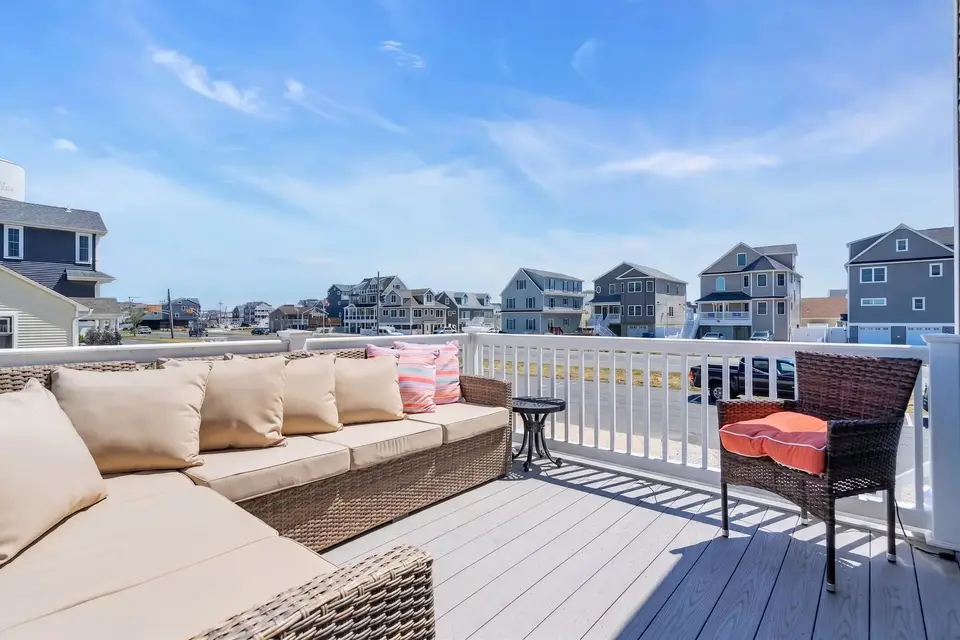
How Breezy approaches Ortley Beach rentals
Ortley Beach is one of the Jersey Shore towns we serve, and you can see the guest side of that work on our Lavallette and Ortley Beach vacation rentals page. For Ortley Beach vacation rental management, compliance is part of the job: tracking insurance and inspection dates, prepping the house for the inspector, putting the registration number on every listing, setting stay minimums by season, and handling guest issues before a neighbor calls.
If you are deciding how much help you need, our post on Airbnb co-host vs full vacation rental management lays out the tradeoffs. If you are still shopping for a house on the island, Buy with Breezy can help you look at a property through a rental lens before you close.
Frequently Asked Questions
Can you Airbnb a house in Ortley Beach?
Yes, from April 1 through November 30, with a minimum stay of two days, under Section 335-40 of the Toms River code. You also need a Rental Certificate of Inspection, an annual insurance registration, and your registration number on every ad.
Can I rent my Ortley Beach house for a weekend in January?
No. The township's inspection packet says seasonal and short-term rentals are not permitted outside April 1 through November 30 on the barrier island. Winter rentals need to be 30 days or longer.
How much does a Toms River rental inspection cost?
The code sets $150 for registration and inspection and $50 for a reinspection or amended registration. Confirm current fees with the Division of Property Maintenance before you apply.
Do Ortley Beach rules match Seaside Heights or Lavallette?
No. Each is a separate municipality with its own process. See our Seaside Heights approval guide and check Lavallette's rules with the borough.
Do I need an inspection to rent my Ortley Beach house?
Yes. No rental unit in Toms River can be rented, occupied or advertised until it is registered and certified. Seasonal rentals must be inspected and certified annually on or before April 30.
When is the Toms River rental insurance registration due?
Every year, on or before January 1, through the SDL Portal.
Is there an Airbnb tax in Ortley Beach?
The state's municipal occupancy tax list dated October 5, 2026 shows a 3% Toms River hotel and motel tax and no separate transient accommodations rate. State Sales Tax and the State Occupancy Fee still apply to marketplace bookings.
Talk to Breezy about your Ortley Beach property
The calendar is the whole game: insurance by January 1, inspection by April 30, short stays April through November, 30-day stays in winter.
If you own in Ortley Beach, or you are close to buying, talk to Breezy about your property. We will walk through how your house fits the Toms River rules and what a season could look like. You can also book a 30-minute call with Jason.
Sources (all accessed November 9, 2026)
- Toms River Township Code, Chapter 335, Article VI, Short-Term Rentals (Sections 335-37 to 335-46). eCode360. https://ecode360.com/32714921
- Toms River Township Code, Chapter 335, Article II, Rental Properties (Sections 335-4 to 335-21). eCode360. https://ecode360.com/12009732
- Toms River Division of Property Maintenance, Rental Certificate of Inspection Packet (Checklist, Guidelines), revised October 2024. https://www.tomsrivertownship.com/DocumentCenter/View/10565/Rental-Inspection-Guidelines
- Toms River Township, Property Maintenance/Rental Applications. https://www.tomsrivertownship.com/177/Property-MaintenanceRental-Application
- Toms River Township, Rental Certificate of Inspection Application. https://tomsrivertownship.com/540/Rental-Certificate-of-Inspection-Applica
- Toms River Township, Beaches. https://www.tomsrivertownship.com/553/Beaches
- Toms River Township, Recreation FAQs. https://tomsrivertownship.com/m/faq?cat=25
- Shorebeat, "Ortley, Barrier Island Rental Homes Will be Spared From New Regulations," April 12, 2017 (background). https://shorebeat.com/lavallette-seaside/2017/04/ortley-barrier-island-rental-homes-will-be-spared-from-new-regulations/
- New Jersey Legislature, N.J.S.A. 40:49-5, Penalties for violations of municipal ordinances. https://lis.njleg.state.nj.us/nxt/gateway.dll/statutes/1/34392/36145
- NJ Division of Taxation, Transient Accommodations Frequently Asked Questions (last updated December 2, 2025). https://nj.gov/treasury/taxation/transientaccommodationsfaq.shtml
- NJ Division of Taxation, Hotels, Motels, and Transient Accommodations: Registering and Collecting Taxes and Fees. https://www.nj.gov/treasury/taxation/occexempt.shtml
- NJ Division of Taxation, Municipal Occupancy Tax List (dated October 5, 2026). https://www.nj.gov/treasury/taxation/pdf/munitaxlist.pdf
- NJ Division of Local Government Services, Local Finance Notice 2026-09. https://www.nj.gov/dca/dlgs/lfns/2026/2026-09.pdf